
To this day, the field of tattooing has not had any clearly formulated rules. But that's finally changing. After four years of negotiations and approvals, a European standard has finally been created that regulates hygiene rules and processes around tattoos. It was put together by an international team of experts, including Míla Bugtcher, the founder of Hell, and Branko Blaščák from the Slovak studio Body Gallery. We talked to Míla about what such an international negotiation looks like and why the standard is important.
WHAT IS THE NORM EXACTLY?
The CEN/TC 435 – Tattooing services standard has been established since 2014. Its initiator was Germany. It is about unifying the rules for tattoos in individual countries and facilitating control over compliance with hygiene and technical principles. The standard will apply to states that vote to adopt it. In this case, it will be one of the EU states plus Switzerland and Britain. Individual states will be able to adjust their legislation according to this standard. It will therefore have a full impact only in a few years.
The CEN/TC 435 standard is currently approved and the final changes are being incorporated. Later this year, we will vote on the final adoption of the standard and it will be officially published at the end of the year.
WHY IS THE STANDARD IMPORTANT?
The rules for tattooing differed in each state and were not precisely established within either country. This means that the employees of the Ministry of Fitness and Hygiene did not have clearly defined rules for inspection. And in various studies, it happened that important steps were often neglected when tattooing, which could lead to a threat to the health of both customers and tattoo artists.
WHAT WILL THE STANDARD BRING TO CUSTOMERS?
The most important thing. The certainty that studies that follow the norm will not endanger their health.
WHAT WILL IT BRING TO TATTOO ARTISTS?
Clearly defined rules that they can follow at work. They no longer have to rely on not always functional habits just because "it is done that way", but they have a precise manual, in compliance with which they will ensure both safety and hygiene at work, but also meet the requirements of the Ministry of Health.
The standard will complicate the lives of those who work with uncertified products, especially from China. For example, in the case of paints, there will be an obligation to inform about the color and batch used and the supplier, which will make it impossible to buy dubious colors somewhere on Aliexpress and then cheat the customer. Those who want to do their job well will finally be able to distance themselves from those who don't care about safety.
HOW DOES THE CREATION AND APPROVAL OF SUCH A STANDARD TAKE PLACE?
The commission was composed of both experts in the field, i.e. tattoo artists, as well as employees of the Ministries of Health, dermatologists and bacteriologists, so it is treated from all sides. The Commission met a total of eight times in four years. For me, this meant seven several days of meetings in different countries. (There were eight meetings in total, but once I was lying at home with a fatal cold.) And on top of that, a lot of work that all the members did between meetings.
Some states had regular delegates to the commission: Germany, France, Britain, the Netherlands, Spain, Switzerland. On behalf of the Czech Republic, the ÚNMZ (Office for Technical Standardization, Metrology and State Testing) approached me as an expert to represent us. Branislav Blaščák from the Body Gallery studio participated for Slovakia. I can't praise Braňa. It was great to have mutual support and an experienced partner in the field in negotiations.
Some countries, such as Poland and Hungary, sent written comments on the standard, but did not personally send delegates.
IS THERE ANYTHING YOU PARTICULARLY CARED ABOUT WHEN YOU PASSED THE STANDARD?
What mattered to me the most was the delay in the acquisition of B-Class autoclaves for all studios. In Hell, we have been using it for a long time, but its mandatory purchase could ruin many smaller studios, for which the expense of over a hundred thousand is unrealistic. That is why I pushed for a solid postponement for them.
I also protested against the use of sterile water cups for tattoos. It's completely inefficient and everyone would bypass it in operation anyway. Fortunately, Braňo from the Body Gallery was also in agreement with me. There were a few other important points for me, but we were not alone against the rest of Europe.
On the contrary, there are also articles in the standard with which we initially disagreed. However, because the committee was composed not only of tattoo artists, but also of other experts, such as bacteriologists, we received relevant documents and changed our minds based on them. One of the significant changes will be the use of sterile ink-cups (small cups in which the tattoo artist prepares the paint before tattooing) in the foreseeable future.
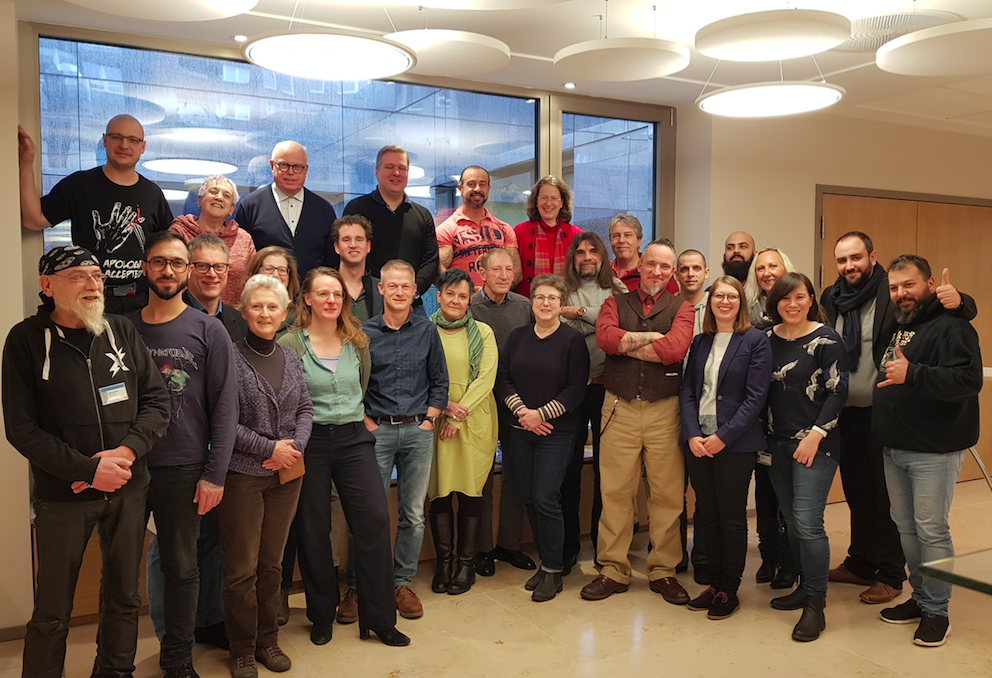
An international team of experts who participated in the creation of the European standard CEN/TC 434, regulating the provision of tattoo services.
Photo: https://gratisography.com/ and archive of Míla Bugtcher.